Now Viewing: International Website

Now Viewing: International Website
Evidence from the BIOADAPTOR RCT demonstrate sustained significant reduction of device-related events with bioadaptor compared to DES, confirming the durability of treatment benefit from 6 months and through long-term follow-up.
Primary endpoint: target lesion failure at 12 months vs. 2.8% for Resolute Onyx™ (p < 0.001)
Increase in blood flow with every heartbeat, as pulsatility returns
Plaque volume regression in lipid rich lesions vs. +10% for DES (p = 0.008)
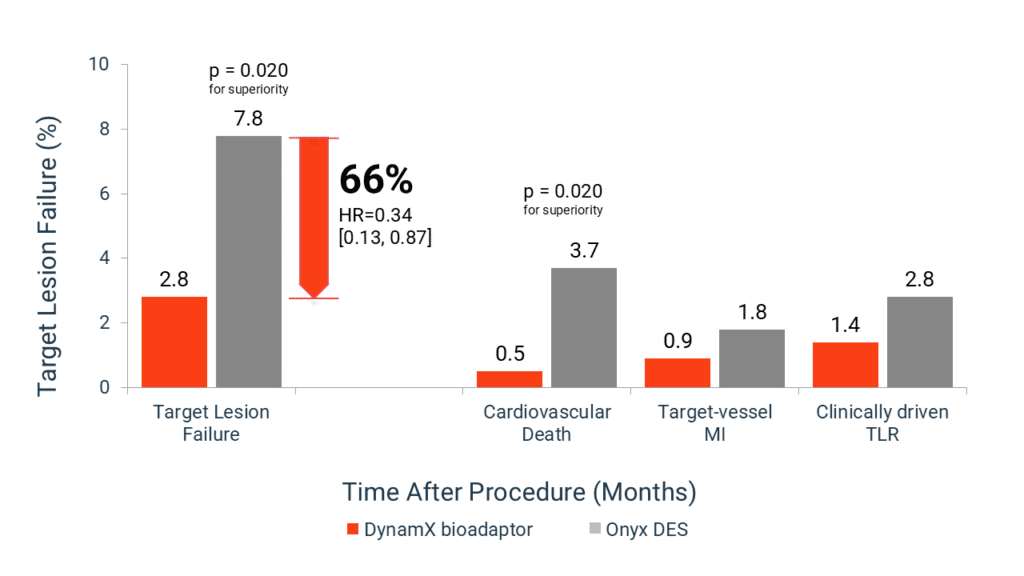
Sustained low adverse event rate from 6 months to 4 years for patients in the DynamX bioadaptor arm compared to drug-eluting stent arm.
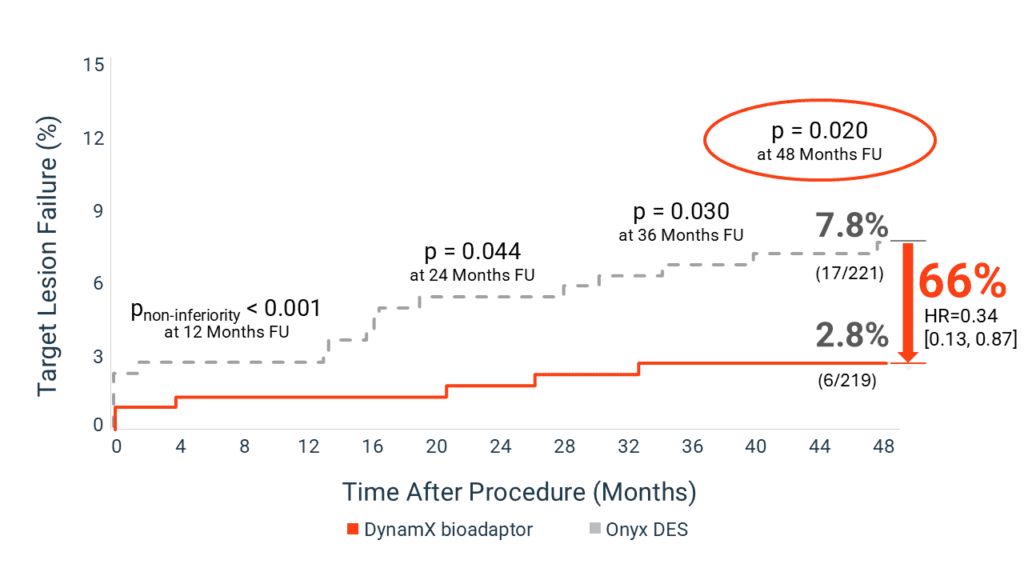
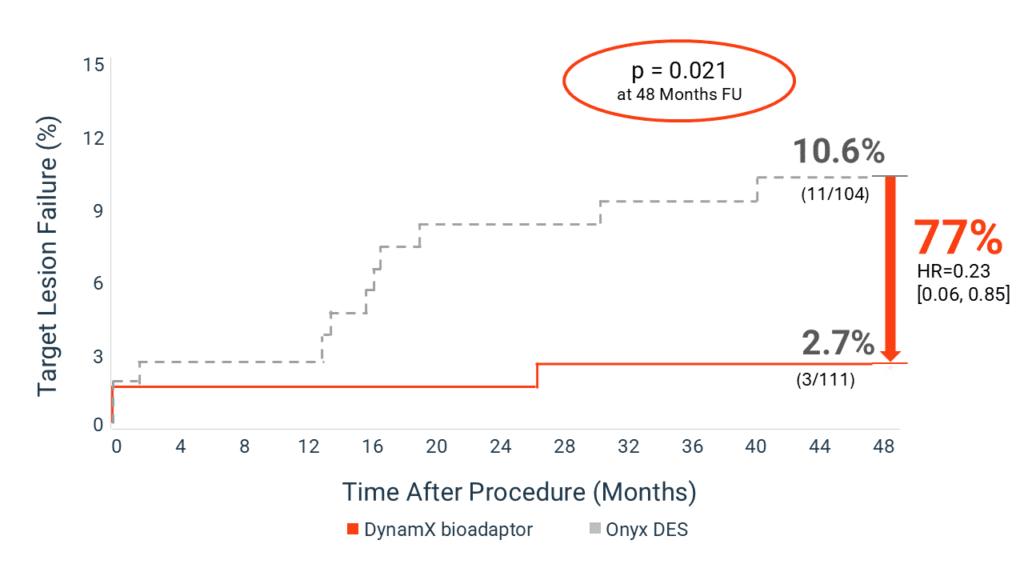
Significantly lower TLF rate demonstrated in LAD lesions in the DynamX bioadaptor arm compared to drug eluting stent arm at 4-year follow-up.
The BIOADAPTOR RCT is an international, single-blinded, randomized controlled (1:1) trial comparing DynamX Coronary Bioadaptor with a contemporary zotarolimus-eluting stent, the Resolute Onyx.™
Move beyond the limitations of permanent stents. Discover how the DynamX Coronary Bioadaptor is designed to unlock natural vessel function and long-term outcomes. Fill out the form to connect with our team.
One of the most important studies of alternatives to drug-eluting stents in PCI is the BIOADAPTOR Randomized Controlled Trial (RCT). This international trial evaluated the DynamX coronary bioadaptor against a leading drug-eluting stent (Resolute Onyx™ DES).
BIOADAPTOR RCT included 445 patients and compared both devices across clinical outcomes, imaging, and long-term follow-up. The study demonstrated that DynamX achieved comparable early results, including TLF at 12 months, and lower rates for TLF at 2 years and 3 years compared to DES.
The BIOADAPTOR RCT showed that while DynamX performed similarly to drug-eluting stents at 12 months, with a comparable target lesion failure percentage (TLF). At longer timeframes, DynamX had statistically significantly lower TLF rates at 2 years and 3 years compared to DES.
At three years:
These results suggest that DynamX may provide long-term advantages and not just short-term procedural success.
In the BIOADAPTOR RCT, DynamX demonstrated:
This data suggests that restoring vessel function may help create conditions that support plaque stabilization and reduction and not just containment.
Non-inferiority means that a new treatment performs at least as well as the current standard of care in key outcomes.
In the BIOADAPTOR RCT:
Target Lesion Failure (TLF) is a key clinical endpoint that includes:
In the BIOADAPTOR RCT:
Lower TLF means fewer complications and better long-term patient outcomes.
The primary endpoint was target lesion failure (TLF) at 12 months. Secondary endpoints included imaging-based assessments of vessel motion, adaptive remodeling, and plaque stabilization using QCA, IVUS, and OCT.
PMN 2500 Rev A
To provide the best experiences, we and our partners use technologies like cookies to store and/or access device information. Consenting to these technologies will allow us and our partners to process personal data such as browsing behavior or unique IDs on this site and show (non-) personalized ads. Not consenting or withdrawing consent, may adversely affect certain features and functions.
Click below to consent to the above or make granular choices. Your choices will be applied to this site only. You can change your settings at any time, including withdrawing your consent, by using the toggles on the Cookie Policy, or by clicking on the manage consent button at the bottom of the screen.
PMN 1777 Rev A