Now Viewing: International Website

Now Viewing: International Website
Evidence from the BIOADAPTOR RCT demonstrate sustained significant reduction of device-related events with bioadaptor compared to DES, confirming the durability of treatment benefit from 6 months and through long-term follow-up.
Primary endpoint: target lesion failure at 12 months vs. 2.8% for Resolute Onyx™ (p < 0.001)
Increase in blood flow with every heartbeat, as pulsatility returns
Plaque volume regression in lipid rich lesions vs. +10% for DES (p = 0.008)
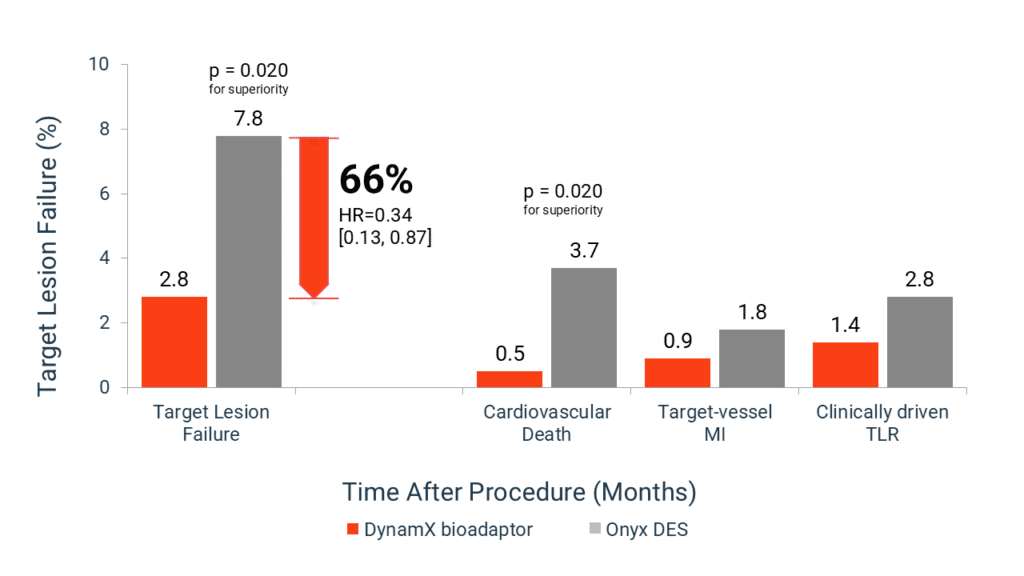
Sustained low adverse event rate from 6 months to 4 years for patients in the DynamX bioadaptor arm compared to drug-eluting stent arm.
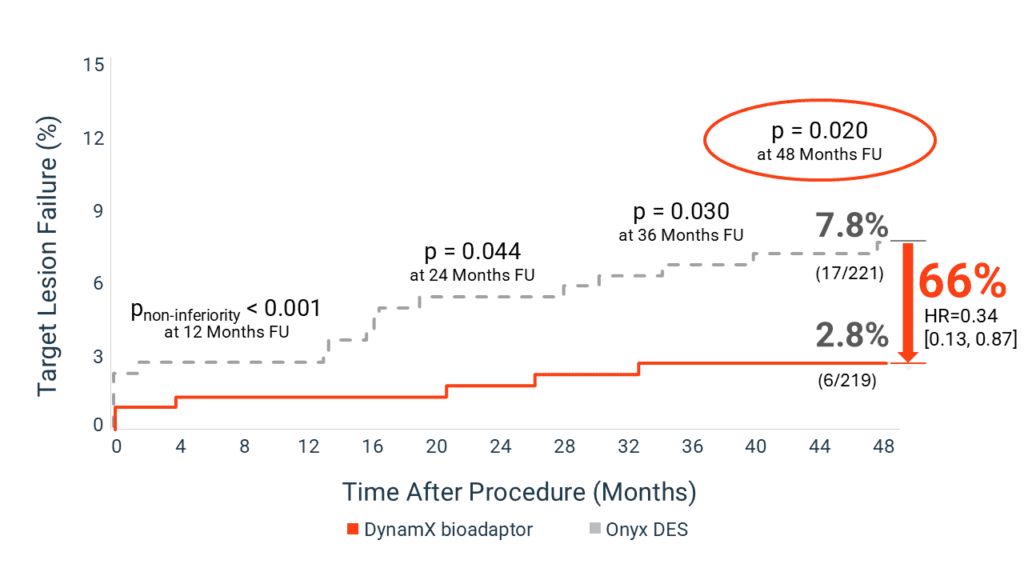
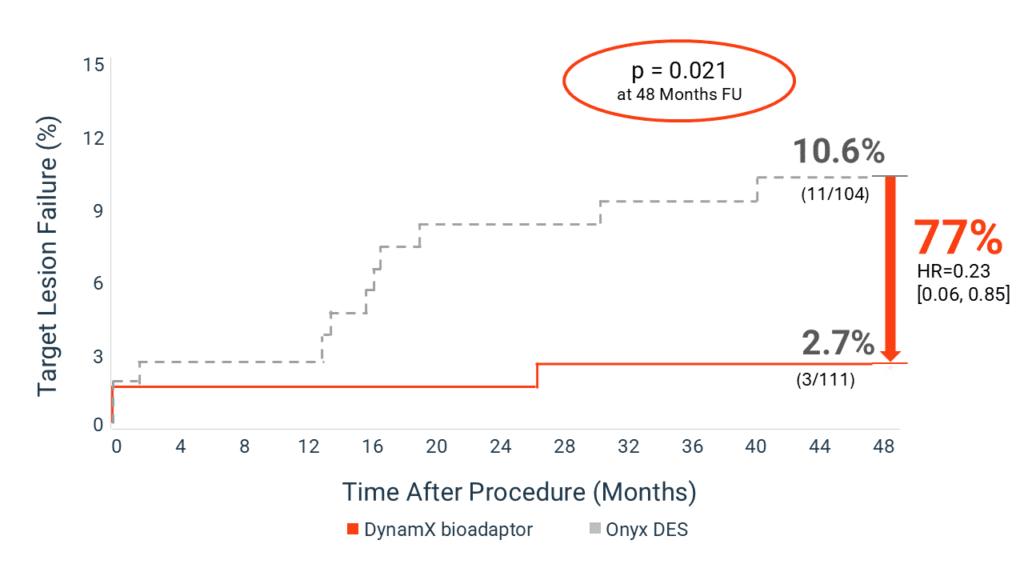
Significantly lower TLF rate demonstrated in LAD lesions in the DynamX bioadaptor arm compared to drug eluting stent arm at 4-year follow-up.
The BIOADAPTOR RCT is an international, single-blinded, randomized controlled (1:1) trial comparing DynamX Coronary Bioadaptor with a contemporary zotarolimus-eluting stent, the Resolute Onyx.™
Move beyond the limitations of permanent stents. Discover how the DynamX Coronary Bioadaptor is designed to unlock natural vessel function and long-term outcomes. Fill out the form to connect with our team.
One of the most important studies of alternatives to drug-eluting stents in PCI is the BIOADAPTOR Randomized Controlled Trial (RCT). This international trial evaluated the DynamX coronary bioadaptor against a leading drug-eluting stent (Resolute Onyx™ DES).
BIOADAPTOR RCT included 445 patients and compared both devices across clinical outcomes, imaging, and long-term follow-up. The study demonstrated that DynamX achieved comparable early results, including TLF at 12 months, and lower rates for TLF at 2 years and 3 years compared to DES.
The BIOADAPTOR RCT showed that while DynamX performed similarly to drug-eluting stents at 12 months, with a comparable target lesion failure percentage (TLF). At longer timeframes, DynamX had statistically significantly lower TLF rates at 2 years and 3 years compared to DES.
At three years:
These results suggest that DynamX may provide long-term advantages and not just short-term procedural success.
In the BIOADAPTOR RCT, DynamX demonstrated:
This data suggests that restoring vessel function may help create conditions that support plaque stabilization and reduction and not just containment.
Non-inferiority means that a new treatment performs at least as well as the current standard of care in key outcomes.
In the BIOADAPTOR RCT:
Target Lesion Failure (TLF) is a key clinical endpoint that includes:
In the BIOADAPTOR RCT:
Lower TLF means fewer complications and better long-term patient outcomes.
The primary endpoint was target lesion failure (TLF) at 12 months. Secondary endpoints included imaging-based assessments of vessel motion, adaptive remodeling, and plaque stabilization using QCA, IVUS, and OCT.
PMN 2500 Rev A
PMN 1777 Rev A