

TRANSFORMING
Vascular Medicine
TRANSFORMING
TRANSFORMING
Vascular Medicine
We tackle big problems in coronary vascular disease
Elixir Medical is innovating next-generation cardiovascular technologies designed to address unmet clinical needs in coronary and peripheral arterial disease. Leveraging deep expertise in implant design, lithotripsy physics, and site-specific therapy, our platforms aim to improve vessel compliance, simplify complex procedures, and support better long-term outcomes for patients. On this site, you’ll find access to our latest clinical insights, technology overviews, and product resources geared for global healthcare professionals and partners.
We use transformation as a solution to improve health and quality of life for patients. By disrupting the status quo, we are going where others have given up.
Innovating at the intersection of clinical need and market opportunity
global annual deaths
from CVD1
annual direct healthcare costs2
PCI patients with a complication within 5 years3
Our technologies
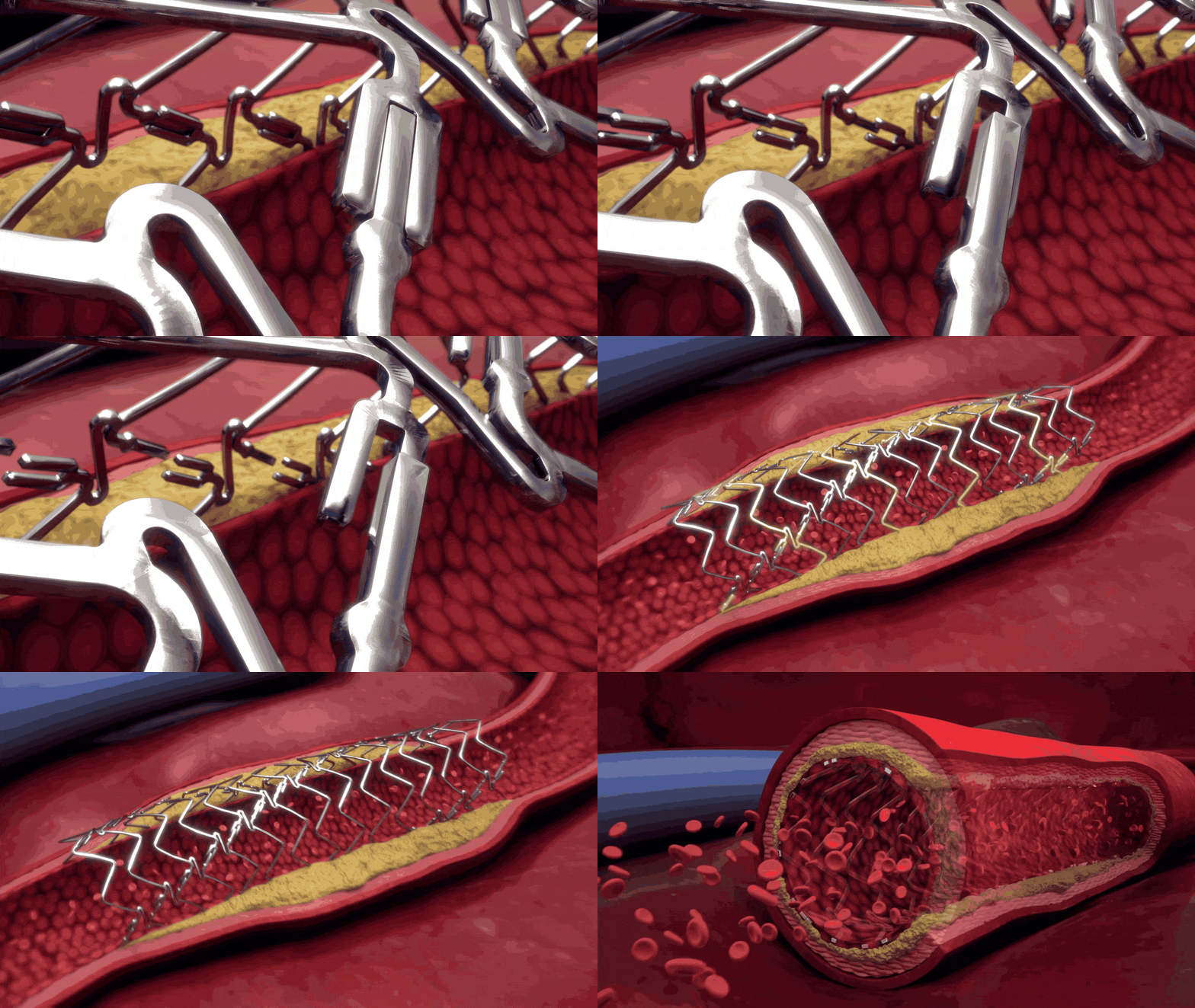
The DynamX Drug-Eluting Coronary Bioadaptor represents a next-generation approach to PCI. Unlike traditional stents, which cage the vessel, DynamX enables adaptive vessel motion following implantation, supporting hemodynamic modulation while maintaining vessel patency. This technology is transforming coronary treatment strategy, integrating mechanical support with restoration of more natural vessel function for long-term treatment benefits.
The LithiX™ Hertz Contact Intravascular Lithotripsy (HC-IVL) system represents a differentiated approach to calcium modification. Positioned as a frontline solution for lesion preparation, LithiX reaches and treats calcified arteries across a broad range of morphologies. Unlike conventional systems that rely on external energy sources, LithiX applies a purely mechanical mechanism within the vessel, using localized Hertz Contact Stress to fracture calcium.

A novel multi-drug platform, the world’s first site-specific antithrombotic triple-drug (TRx) therapy combines two anticoagulants with an antiproliferative agent to deliver targeted therapy directly at the site of intervention. By localizing treatment, TRx is engineered to manage thrombotic risk while reducing reliance on systemic exposure, introducing a novel strategy to balance efficacy and bleeding risk in coronary intervention.
Built on Evidence. Proven in Practice.
From rigorously designed randomized controlled trials to real-world case studies, our clinical evidence spans the full spectrum of research, validated through peer-reviewed publications and physician-led investigation.

Randomized
Controlled Trials

Physician-led
Studies

3250+
patients studied

Peer-reviewed
Publications
"Drug-eluting stents have been a blessing in the field of interventional cardiology. Nevertheless, the permanent cage, which prevents vessel remodeling, is a limitation. I believe that keeping the vessel as natural as possible is a positive feature (of the bioadaptor)."
Professor Antonio Colombo, MD
"The mechanism is fractures that allow the stent to expand properly. At this stage, it constitutes a promising alternative, and in any case, provides us with another tool in our arsenal.”
Dr. Frédéric Bouisset
“The bioadaptor is a revolutionary innovation in percutaneous coronary intervention.”
Dr. Shigeru Saito
“What sets the bioadaptor apart is that it allows the vessel to move more naturally. I think it does not restrict its natural motion. It is a much more physiologic implant than our traditional stents.”
Dr. Mladen Vidovich
“I'm excited about the bioadaptor technology. It's a new kind of device that's different from traditional stents. This innovative approach can potentially overcome DES's limitations and improve how we treat CAD.”
Manh-Hung Pham, MD
“The LithiX Hertz device is designed to treat a broad range of moderate to severe calcific lesion. It is safe. It can be easily Incorporated in the PCI workflow.”
Dr. Valeria Paradies
“Based on the fact that this device has so many wonderful characteristics and so much positive potential, this is something that every physician should be keen on using in his clinical practice.”
Stefan Verheye, MD
Frequently Asked Questions
Why are new PCI technologies being adopted globally?
New PCI innovations are being adopted globally to support better acute and long-term patient outcomes.
Bioadaptor technology is one such innovation and serves as an alternative to drug-eluting stents. The coronary implant is designed to unlock 6 months after PCI and enable adaptive remodeling and a restoration to a more natural state, while still providing dynamic support.
Hertz Contact intravascular lithotripsy (HC-IVL) is another newer PCI technology, offering calcium modification with a simpler workflow across calcium morphologies and in difficult-to-reach lesions.
Where are advanced PCI technologies currently available?
Availability of advanced technologies for PCI varies by region. Some technologies are commercially available in Europe, the Middle East and Asia.
DynamX bioadaptor and LithiX Hertz Contact intravascular lithotripsy (HC-IVL) are both CE Marked.
Physicians are using both devices in clinical practice in many countries according to local regulatory approvals.
Are there alternatives to stents in percutaneous coronary intervention (PCI)?
Yes. In addition to drug-eluting stents, alternatives include bioadaptor technology, which provides dynamic support for the diseased vessel without permanently caging the artery. This approach aims to improve long-term vessel health and reduce complications.
Unlike traditional drug-eluting stents that permanently cage the artery, the DynamX Coronary Bioadaptor is designed to restore vessel motion and adaptive function after the vessel heals. This bioadaptive technology allows the artery to regain pulsatility, compliance, and natural blood-flow dynamics over time.
Who can benefit from advanced PCI technologies?
PCI treatment is intended for patients with coronary artery disease. Advanced technologies are especially important for patient cases where traditional approaches may have limitations.
Treatment of complex lesions, blockage in the left anterior descending artery (LAD), and patients with acute coronary syndrome may have specific benefits for treatment with bioadaptive angioplasty.
Patients with eccentric, concentric or nodular calcium morphologies and patients with lesions in difficult to reach places, such as those with tortuous anatomy, may benefit from treatment with LithiX Hertz Contact intravascular lithotripsy. Treatment decisions are made by physicians based on individual patient needs.
What clinical challenges are PCI innovations designed to address?
PCI innovation is currently focused on addressing several persistent challenges in interventional cardiology, including:
- Coronary artery disease
- Calcified lesions that complicate PCI procedures
- Long-term complication rates
Elixir Medical’s innovations are designed to improve lesion preparation, restore natural vessel behavior, and support long-term patient outcomes.
What clinical experience exists for Elixir Medical technologies?
Elixir Medical technologies are supported by a growing body of clinical evidence, including peer-reviewed publications, randomized controlled trials, and real-world clinical experience.
The DynamX® bioadaptor is supported by multiple peer-reviewed studies demonstrating safety, effectiveness, and durable long-term outcomes. This includes two randomized controlled trials, one of them a large-scale, multi-center study enrolling approximately 2,400 patients. Additional evidence includes physician-led case studies and both single-center and multi-center clinical experiences presented at major international cardiology conferences such as TCT and EuroPCR.
The LithiX™ Hertz Contact intravascular lithotripsy (HC-IVL) system is supported by peer-reviewed data demonstrating safety and effectiveness across a range of calcium morphologies and lesion types. Clinical results have shown consistent plaque fracture and stent expansion, validated using multiple intravascular imaging modalities. Supporting evidence also includes case studies and clinical experiences from both single and multi-site use, presented at leading conferences including TCT and EuroPCR.
References
- Based on cases and mortality of CVD (95% uncertainty intervals: 17.4 to 20.4 million) in globally 2023. Global Burden of Cardiovascular Diseases and Risks 2023 Collaborators. Global, regional, and national burden of cardiovascular diseases and risk factors in 204 countries and territories, 1990-2023. JACC. 2025 Dec, 86(22) 2167-2243. https://doi.org/10.1016/
j.jacc.2025.08.015. - Bray G., Darrow B., Skedgel C. , The burden of LDL-cholesterol-driven atherosclerotic cardiovascular diseases (2026). https://www.ohe.org/publications/
the-burden-of-ldl-cholesterol-driven-atherosclerotic-cardiovascular-diseases/ - Percentage of patients that experience an adverse event within 5 years after PCI procedure. Stone, GW, et al. Five-year outcomes after PCI or CABG for left main coronary disease. N Engl J Med. 2019, 381(19) 1820-1830. https://doi.org/10.1056/
NEJMoa1909406.
- Based on cases and mortality of CVD (95% uncertainty intervals: 17.4 to 20.4 million) in globally 2023. Global Burden of Cardiovascular Diseases and Risks 2023 Collaborators. Global, regional, and national burden of cardiovascular diseases and risk factors in 204 countries and territories, 1990-2023. JACC. 2025 Dec, 86(22) 2167-2243. https://doi.org/10.1016/j.jacc.2025.08.015.
Bray G., Darrow B., Skedgel C. , The burden of LDL-cholesterol-driven atherosclerotic cardiovascular diseases (2026). https://www.ohe.org/publications/the-burden-of-ldl-cholesterol-driven-atherosclerotic-cardiovascular-diseases/
- Percentage of patients that experience an adverse event within 5 years after PCI procedure. Stone, GW, et al. Five-year outcomes after PCI or CABG for left main coronary disease. N Engl J Med. 2019, 381(19) 1820-1830. https://doi.org/10.1056/NEJMoa1909406.
PMN 1708 Rev D